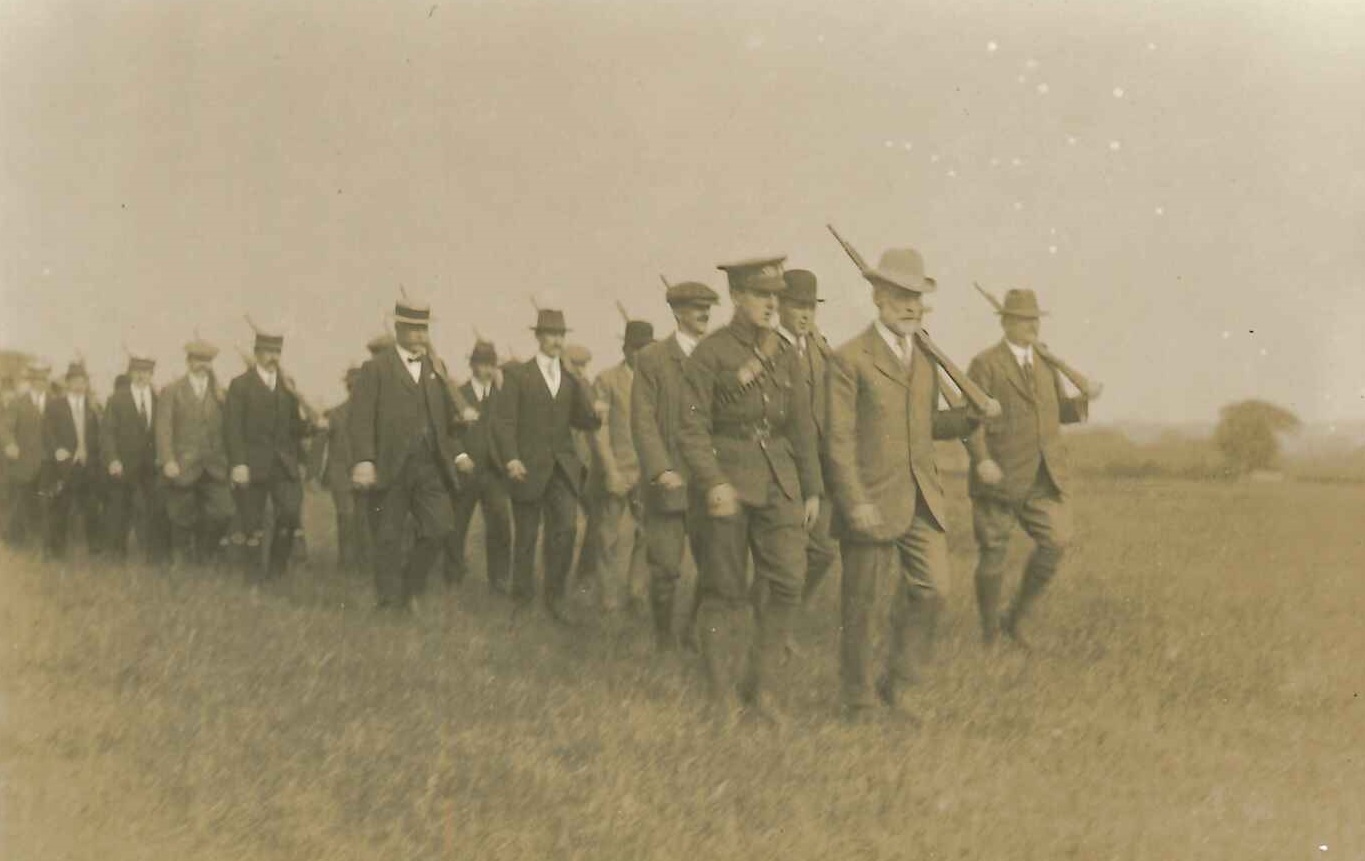
John McCrea the Wellington Volunteers
When John Alexander McCrea was born in Wolverhampton in 1874 his parents, a travelling salesman and a washer woman, would not have expected him to become a highly respected member of the community of Wellington in Shropshire.
John McCrea, the eldest of two sons, followed his father in becoming a traveling salesman. Although it is unclear what the nature of his business was, he moved to Shropshire sometime between 1891 and 1911, most likely when he married Louisa Pointon in 1903. McCrea was socially ambitious. Marriage to Louisa would have been a step up for him, as the Pointon family had successful business interests in the Wellington area, owning the Station Hotel, the Red Lion public house and several other endeavours. By 1911 McCrea, aged 37, was living a comfortable middle class life in Wellington. The McCrea family included four young children and lived in a seven-room house on Mill Bank. The family had a live-in maid, Elsie, aged 17, and McCrea was the sole earner.
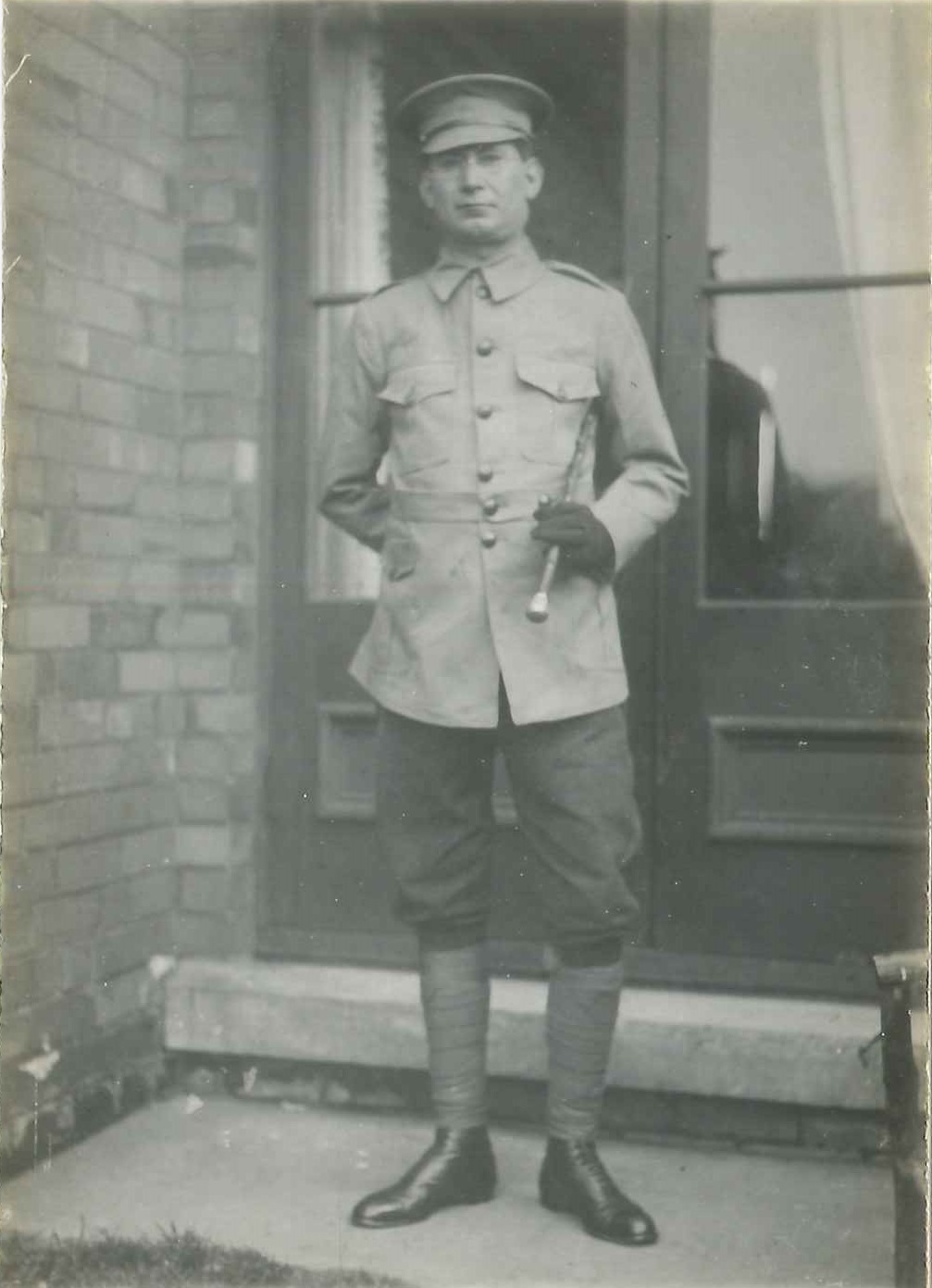
John McCrea pictured in 1915 in his newly purchased volunteers uniform Shropshire Archives ref. 8335/10/5/6
Unlike his brother, who had served with the 6th Dragoons, McCrea was not a military man. However, when war broke out in 1914, like many men of his age and position McCrea’s lack of experience did not waver his determination to participate in the war effort. He most likely heard the news of war with his fellow townsfolk. On 4 August 1914, the people of Wellington gathered in the town square to hear the news that Britain had declared war on Germany.
During the early stages of the war, Britain was reliant on a voluntary enlistment system to expand forces overseas. This huge volunteer force was nicknames ‘Kitchener’s Army’, after a recruiting campaign by Lord Kitchener, secretary of state for war.
Many Wellington men, like McCrea, felt unable to volunteer for the army. Some were too old, others were business owners unable or unwilling to leave their livelihoods behind, and there was still belief in the Victorian principle that warfare overseas should be for professional soldiers. As a middle-aged business man, the 41-year old McCrea was unable to go on active service due to his age and responsibility at home and at work.
Local volunteer militias began to spring up all over the country almost as soon as war was declared. Volunteer corps were widely supported by the popular press, and advocates of local defence such as Sir Arthur Conan Doyle increased their popularity. Wellington was no exception to the national trend.
On Monday 5 September 1914 the Wellington District of the War Assistance Committee met at Edgbaston House in Birmingham to discuss volunteering in the region. It was decided Wellington should form a civilian volunteer corps and on Friday 11 September a meeting was held in the Grand Theatre on Tan Bank, Wellington under the presidency of Mr G. Paddock. A large hall was promised to the corps for meetings and training, and they went about the next job of finding a drill instructor and recruiting volunteers.
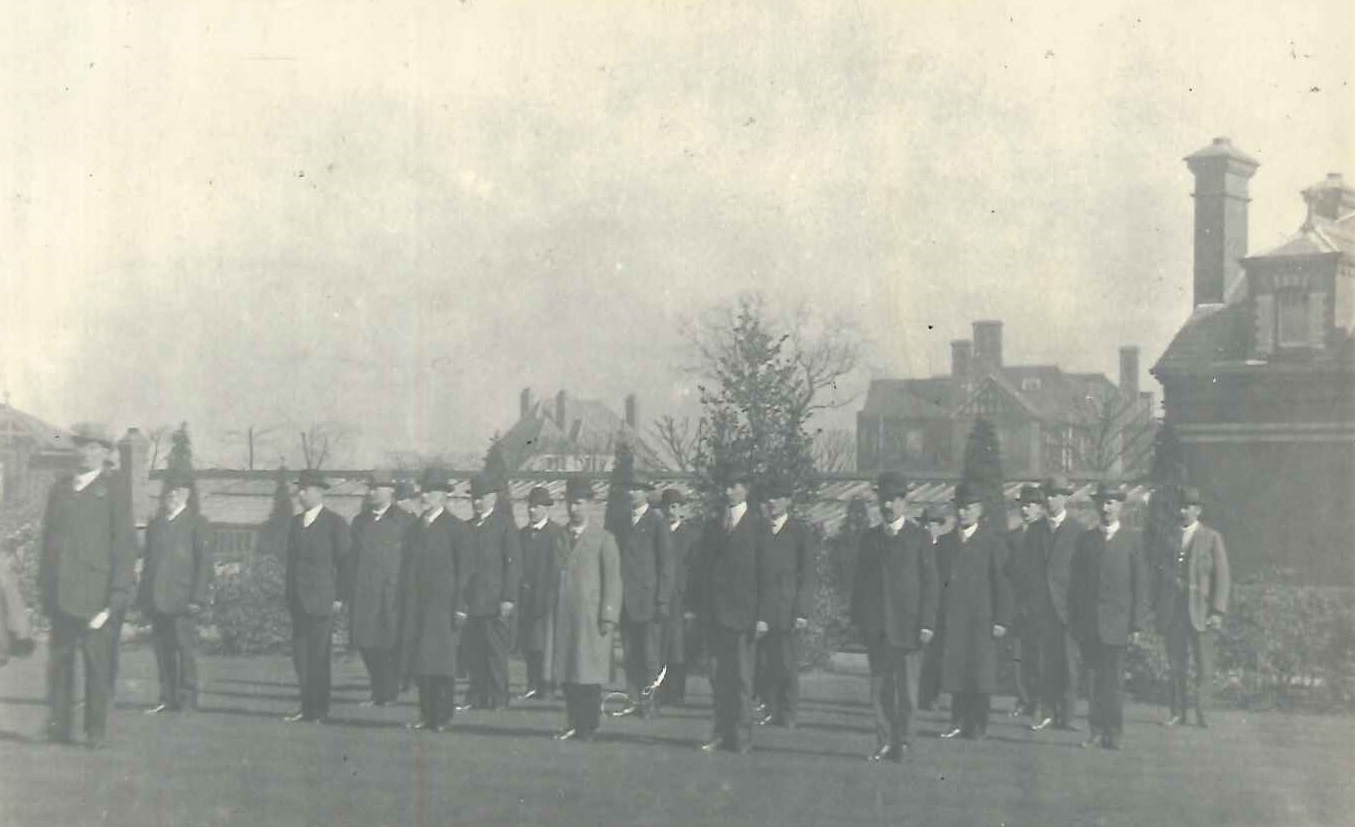
Members of the Wellington Volunteer Civilian Corps practicing drill. Shropshire Archives ref. 8335/10/5/1
Today we have the image of local home front defence in the World Wars as somewhat bumbling, thanks to comedies such as Dad’s Army. However, this was not the case for the Wellington Civilian Volunteer Corps (WCVC). The Wellington Journal described the formation of the WCVC undertaken with ‘conspicuous enthusiasm’. Volunteers came from all classes of the community. The corps was well respected in Wellington, where volunteering became a staple of the war effort. Wellington had formed a volunteer hospital, a Red Cross contingent and the local scouts helped with patrolling.
Early training of the WCVC was inevitably rather amateur, with the men dressed in their formal clothing including bowler hats, long jackets and walking boots. Weekly drill sessions were set for Mondays and Tuesdays, with route marches, rifle practice and general manoeuvres to be introduced as the war progressed.
However, as the popularity of local civilian defence corps grew, centralised control began to develop. In particular, the London Volunteer Defence Corps began the movement to towards more professionally structured home defence. With the grudging support of the government (lacking time or resources to manage the growing number of local defence initiatives), the central London committee became the Central Association of Volunteer Training Corps, to which all other volunteer training corps could affiliate. Ex-military personnel of the national reserve took leading roles growing and leading local volunteer units. Regional battalions were formed, giving the volunteer corps a more professional military structure. Wellington was no exception. The WCVC were overseen by the Earl of Powys, the lord lieutenant of Shropshire, and more locally by Lord Stafford and one Captain Forrester.
By October 1915, the men of the WCVC could purchase wool serge caps, tunics and Bedford cord breeches for 37 shillings. This uniform gave them a more professional look in line with the growing professionalism of volunteer corps in Britain. John McCrea took the opportunity to sport this new look in a series of postcards.
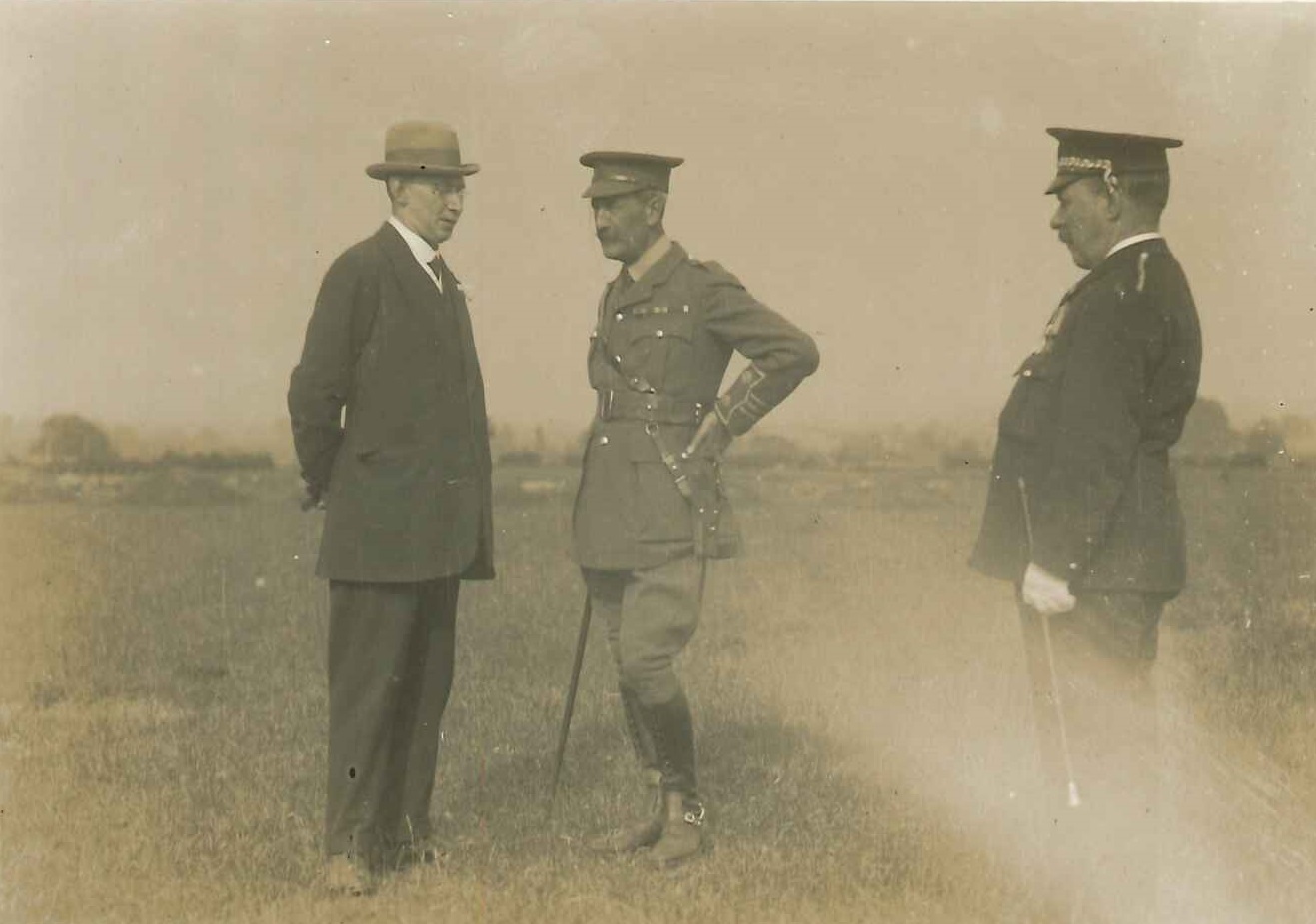
McCrea (left) in conversation with Lord Stafford and Captain Forrester of the WCVC. Shropshire Archives ref. 8335/10/5/4
McCrea patriotically promoted the WCVC, and it also gave him opportunity for social advancement. In January 1915 he became honourable secretary of the WCVC, and by December 1915 the Earl of Powys had appointed him battalion quartermaster. McCrea’s rank within the WCVC allowed him opportunity to move in new social circles. He was in regular contact with his senior officer Captain Forester and was involved in the WCVC being recognised more widely. Lord and Lady Stafford become patrons of the corps, and in July 1915 a ceremony and parade was held in the grounds of Wellington College to present corps members with brassards acknowledging their service.
McCrea’s story shows how participation in local volunteer units allowed the townsfolk of Wellington to ‘do their bit’ for the war effort, while some gained social advancement. John McCrea was well respected, and he continued to serve as an active and important member of the WCVC until his death in 1917.
By Lauren Hamilton, reading History at University Centre Shrewsbury.
